How Artists Choose Artwork Size Inspiration Space Sales and 2027 Market Trends
A painting can begin as a quick sketch and end up six feet wide. A sculpture can start with a hand-sized clay model, then demand a crane, a loading dock, and a larger budget than expected. For visual artists, size is never just a number on a label. It shapes how the work feels, how it gets made, where it can be shown, and whether it can find a buyer.
Artwork size sits at the meeting point of three forces: inspiration, space, and sales. The subject may ask for intimacy or scale. The studio may set hard limits. The market may reward sizes that fit over a sofa, ship easily, or look striking in a gallery booth.
Those forces shift by medium. A 60-inch painting carries different risks than a 60-inch ceramic sculpture. A mixed media wall piece may be light but fragile. A bronze may be small but expensive to cast. The best size choice is rarely about going bigger or smaller by default. It is about matching the idea to the material, the venue, and the practical life of the work.
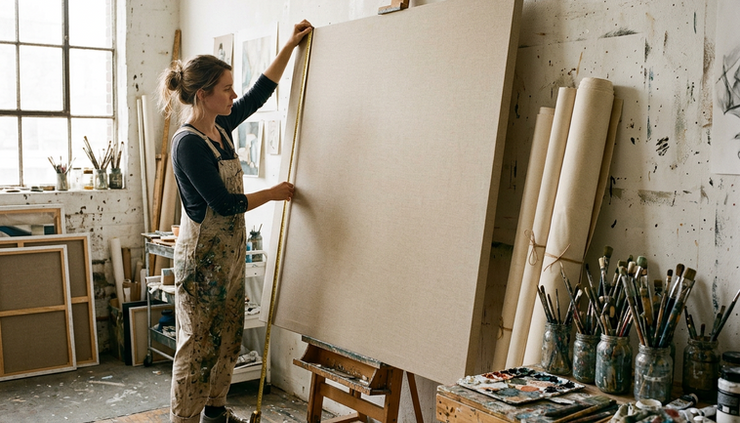
Inspiration often sets the first size limit
Many artists choose size before they choose color, material, or final composition. The first question is not always “How big can this be?” More often, it is “How close should the viewer feel?”
Small work invites close looking. It slows the viewer down. A miniature portrait, a small still life, or a compact abstract panel can feel private, almost like a note passed by hand. Large work changes the body’s role. Viewers step back, turn their heads, and feel surrounded or confronted.
Subject matter often points the way.
A grief painting may need a narrow, confined format. A seascape may need horizontal room. A portrait of one person may gain power through life-size scale. A painting about protest, migration, climate, or public memory may feel too compressed on a small panel. On the other hand, an enormous painting of a quiet cup on a table may create productive tension by making the ordinary feel monumental.
Scale also controls rhythm. A small canvas can hold one sharp gesture. A large canvas lets a mark travel across the surface. In sculpture, a small figure can feel precious or vulnerable. A larger one can feel social, architectural, or imposing.
Artists often test scale through low-risk studies:
Thumbnail sketches to compare proportions
Paper cutouts taped to a wall
Small maquettes for sculpture
Digital mockups placed into room photos
Full-size charcoal studies on kraft paper
Cardboard or foam models for installation work
These tests reveal whether an idea has enough visual weight for a large format. Some images weaken when enlarged because the subject does not gain complexity. Others need size to breathe.
A useful rule of thumb: if the concept depends on bodily impact, scale matters. If the concept depends on precision, secrecy, or quiet attention, smaller dimensions may carry more power.
History shows that size has always carried meaning
Artwork size has long reflected power, patronage, technology, and audience.
In ancient and medieval art, scale often signaled importance. Monumental statues, temple reliefs, mosaics, and altarpieces were made for public or sacred spaces. Size helped viewers read the work from a distance and feel the authority of the site. A small devotional object served a different purpose. It fit private prayer, travel, and touch.
During the Renaissance, scale became tied to architecture and patronage. Frescoes filled chapels and civic buildings. Large portraits and history paintings communicated wealth, status, and ambition. Artists did not choose size only for expression. The wall, the patron, and the intended audience shaped the work.
In the 19th century, academic painting often rewarded large canvases, especially historical and mythological scenes. At the same time, portable easel paintings became more common through private collecting, changing homes, and new art markets. Impressionist works often used manageable formats because artists painted outdoors and moved quickly.
The 20th century brought a major shift. Modern artists pushed scale as a form of experience. Jackson Pollock’s large drip paintings made the canvas a field of action. Mark Rothko’s large color fields created a room-like emotional pull. Helen Frankenthaler, Barnett Newman, Clyfford Still, and others used size to make abstraction feel physical, not decorative.
Sculpture changed too. Constantin Brancusi refined compact forms, while later artists such as Louise Bourgeois, Richard Serra, Claes Oldenburg, and Yayoi Kusama explored scale as environment, memory, or spectacle. Land art went further. Works by artists such as Robert Smithson and Nancy Holt used the open site itself as part of the scale decision.
Contemporary artists inherited all of these options. A work can be intimate, domestic, architectural, public, or immersive. Size no longer has one meaning, but it always has a meaning.
Some artists grow larger over time
Many artists increase scale as their confidence, resources, and audience grow. This pattern appears across mediums.
An artist may begin with small studies because they are affordable and easy to finish. As the visual language becomes clearer, larger work becomes possible. A mature style often needs more room because the artist understands which marks, forms, or materials can hold attention at scale.
Jackson Pollock did not start with the famous mural-sized drip paintings that define his public image. His move into larger canvases developed with his process. Once he placed canvas on the floor and worked from all sides, scale became part of the method.
Georgia O’Keeffe offers another kind of enlargement. Her flower paintings often magnified natural forms so that small subjects became monumental. The increase was not just physical. It changed how viewers perceived the subject.
Mark Rothko’s move toward large fields of color also shows how size can deepen an artist’s aim. His mature paintings rely on the viewer’s physical presence. A small Rothko-like format would not create the same pressure, glow, or silence.
In sculpture, Richard Serra’s work shows a clear commitment to increasing scale and bodily experience. His large steel works ask viewers to move through and around them. The size is not decoration. It is the work’s central condition.
El Anatsui’s large metal wall pieces show another path. His work often uses bottle caps and metal fragments assembled into flexible surfaces. The scale allows many small elements to become one vast, shimmering form, while still preserving evidence of touch and labor.
Artists grow larger for different reasons:
Their subject asks for public presence
Their gesture becomes more physical
Their collectors and galleries can support larger work
Their studio capacity improves
Their materials become more ambitious
Their reputation allows higher production risk
Still, many strong artists move in the opposite direction. Some return to small formats after major public projects because small work can restore speed, privacy, and experimentation.
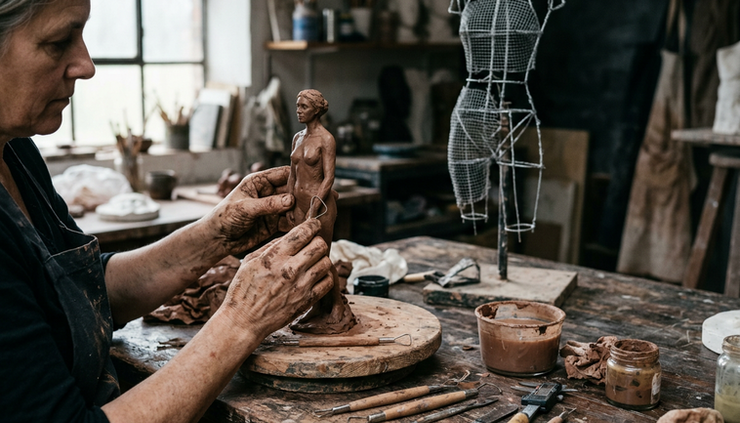
Paintings balance wall impact with practical limits
Painting gives artists wide freedom in size, but also creates familiar problems. Canvas, panels, stretchers, paint volume, framing, drying space, and shipping all grow more demanding as dimensions increase.
Small paintings create intimacy and flexibility
Small paintings, such as 8 by 10 inches, 12 by 12 inches, or 16 by 20 inches, offer clear advantages. They cost less to make, store easily, and fit more homes. They are also easier for first-time collectors to buy.
Small formats work especially well for:
Daily painting practices
Still lifes
Studies and plein air work
Small portraits
Color experiments
Collectible series
Small paintings can sell steadily because they reduce friction. A buyer does not need a large wall, special shipping, or a major budget. For artists building an audience, small work can create consistent entry points.
The risk is that small work may be undervalued if the artist’s market equates size with seriousness. That is a market perception, not an artistic truth, but it affects pricing.
Medium paintings often fit the broadest market
Medium works, such as 18 by 24 inches, 24 by 30 inches, 30 by 40 inches, and similar ranges, often sit in the market’s comfort zone. They feel substantial but still fit apartments, houses, and many gallery walls.
This range appeals because it solves several problems at once. The work has enough presence for a main living area, but it can still ship without extreme handling. It can be framed without custom engineering. It can be stored in flat racks or standard bins.
For many painters, medium sizes become the backbone of a sustainable studio practice. They offer room for expression without the full cost of monumental work.
Large paintings make a statement but narrow the buyer pool
Large paintings can transform a room. They attract attention in galleries and art fairs because they read from a distance. They photograph well when installed in clean spaces. For artists seeking museum, public, or high-end residential opportunities, large work can matter.
The tradeoff is real. Large paintings need more materials, more time, stronger stretchers, more storage, and careful transport. They can also limit sales because fewer buyers have the wall space.
Large work may be right when the artist’s language needs scale. It may be risky when size serves only as spectacle.
Sculpture size depends on mass, material, and site
Sculpture brings size into three dimensions. A sculpture’s footprint may matter more than its height. Weight may matter more than visual scale. Material can turn a modest object into a major logistical project.
A 24-inch foam sculpture can be easy to move. A 24-inch marble carving can require equipment and specialized handling. A slender steel work may be tall but stable only with the right base. A ceramic piece may be small but fragile.
Tabletop sculpture favors collectors and editions
Smaller sculpture often works well for private collectors because it can sit on a shelf, pedestal, mantel, or table. It ships more easily than large sculpture and can fit into homes without construction.
Artists who cast bronze, resin, or metal editions may prefer smaller formats because editioning costs stay more manageable. Buyers also understand how to live with the work.
Human-scale sculpture creates relationship
Sculpture near the size of the human body can create a strong emotional connection. It shares space with the viewer. Figure, abstraction, and assemblage all gain tension when they occupy the viewer’s physical world.
This scale can also suit galleries because it has presence without requiring outdoor installation, cranes, or major site preparation.
Monumental sculpture needs a site first
Large sculpture usually requires a site, or at least a realistic path to one. Public art commissions, sculpture parks, university campuses, hospitals, civic plazas, and corporate collections often support large works. Without a likely site, artists carry high risk.
For large sculpture, size decisions must account for:
Structural engineering
Weather resistance
Installation equipment
Permits or site rules
Public safety
Long-term maintenance
Insurance and transport
A large sculpture may sell for more, but the cost of making it can rise long before a buyer appears.
Mixed media and installation art add hidden size questions
Mixed media artists often deal with irregular shapes, layered surfaces, unusual materials, and fragile attachments. Size decisions involve not just height and width, but depth, weight, and vulnerability.
A mixed media wall piece with fabric, found objects, paper, acrylic, and metal may look easy to hang. It may also need custom crating because raised elements can break. A large collage may respond to humidity. A textile work may require special hanging systems.
Installation art expands the question further. The work may not have a fixed size until it enters a room. Some installations adapt to each site. Others use strict dimensions because the viewer’s path, sound, light, or sequence matters.
For installation artists, the size decision often starts with the body:
Where does the viewer enter?
Can more than one person experience the work at once?
Does the work create compression or openness?
What does the viewer hear, touch, or avoid?
How does the piece change from ten feet away compared with two feet away?
Mixed media and installation can also challenge sales. A collector may love the work but hesitate if it requires special storage, complex assembly, or conservation instructions. Clear documentation helps. So do modular parts, simple hanging systems, and honest installation notes.

Workspace often decides what is possible
Inspiration may start the size choice, but the studio often finishes it. A painter working in a spare bedroom faces different limits than an artist with a warehouse studio. A ceramicist must consider kiln size. A printmaker must consider press bed dimensions. A photographer may consider print size, edition storage, and framing.
Workspace affects size in simple ways:
Ceiling height limits upright work
Doorways limit finished dimensions
Floor space limits large canvases and sculpture bases
Ventilation limits certain materials
Drying racks limit painting volume
Kilns, presses, and tables create fixed maximums
Shared studios limit long-term storage
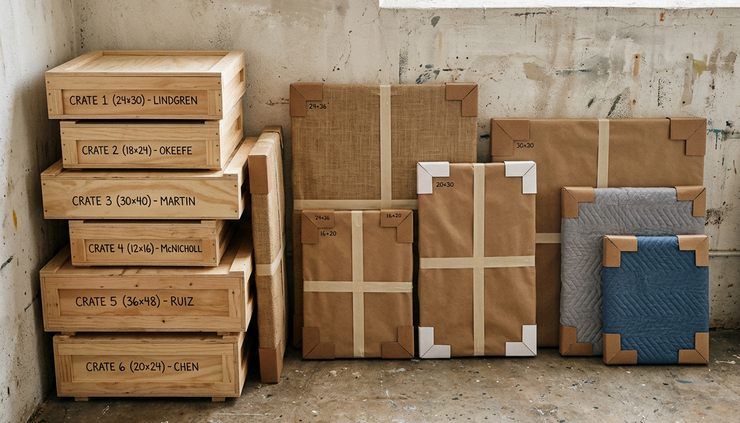
The doorway problem catches many artists. A work can be made inside a studio but fail to leave it. Large painters often build canvases that can be unstretched and rolled. Sculptors may design modular parts. Installation artists may pack work into labeled crates and rebuild it on site.
Display considerations matter too. Artists often imagine where the work will live. A gallery wall can handle more visual risk than a narrow hallway. A collector’s home may have standard ceiling heights. A public lobby may need durable materials, big scale, and long viewing distances.
A strong size choice respects both the idea and the future path of the object. If a work cannot be moved, stored, installed, or maintained, its artistic power may never reach an audience.
Sales trends favor livable scale, but statement works still matter
The art market does not speak with one voice. Blue-chip galleries, local art fairs, online shops, interior designers, public art programs, and open studios all reward different sizes. Still, some patterns have become clearer in recent years.
Many buyers want art that fits real living spaces. That often points toward small and medium work, especially pieces that can ship safely and hang without major planning. Online sales have strengthened this preference because buyers rely on photos, mockups, and size descriptions. A work that arrives ready to hang has an advantage.
At the same time, galleries and fairs still use large works to create impact. A large painting can anchor a booth. A big sculpture can define an entrance. Museums and major collectors still seek scale when the work justifies it.
Recent shifts include:
Strong interest in medium-sized statement pieces for residential interiors
Continued demand for small works from emerging artists
More comfort buying art online, which favors clear dimensions and manageable shipping
Interest in modular work that can fit different spaces
Growth in design-led collecting, where size and room placement matter early
Higher sensitivity to shipping costs, especially for oversized or fragile work
The market also changed because many collectors now live with flexible layouts. Apartments, condos, remote-work rooms, and multi-use spaces have increased interest in pieces that can move from one wall to another. Large art still sells, but it often needs the right buyer, the right room, or the right commission.
Financial pressure grows faster than dimensions
A work that is twice as wide and twice as tall is not simply “twice as big.” It has four times the surface area. In sculpture, volume and weight can increase even faster. That math changes everything.
Supplies rise with surface area and material waste
Large paintings require more canvas, stretcher bars, primer, paint, varnish, and framing material. Large panels may need bracing to resist warping. Works on paper may need archival mounting or oversized framing.
Sculpture costs vary even more. Clay, plaster, wax, resin, wood, steel, bronze, stone, glass, and found objects each carry different cost curves. Casting and fabrication can make scale expensive quickly.
Mixed media adds uncertainty because unusual materials may need testing. Adhesives, sealants, backing panels, hanging hardware, and conservation-safe choices all carry costs.
Time expands in visible and invisible ways
Large work takes longer to make, but not only because of surface area. Artists spend added time preparing supports, moving pieces around the studio, waiting for layers to dry, reinforcing structures, documenting progress, and fixing scale-related problems.
A small painting can be finished in one concentrated session. A large painting may require repeated physical effort and fresh decisions over weeks or months. That time should shape pricing, scheduling, and production plans.
Transportation can reshape the whole project
Shipping and handling may decide whether a size makes sense. Oversized packages cost more, require stronger packing, and face higher risk. Freight shipping, art handlers, crates, climate concerns, and insurance can change the budget.
Some artists build large paintings on unstretched canvas so they can roll and ship them. Others create diptychs or triptychs that read as one large work but move in sections. Sculptors may design removable bases or modular components.
Storage is a silent cost
Storage rarely gets enough attention. Unsold work occupies space. Large work can block new production. Fragile work needs safer storage. Climate-sensitive materials may need better conditions.
Artists who price large work only by materials and labor may miss this hidden cost. Space has value. So does the ability to keep working without a studio packed full of unsold inventory.
The financial lesson is clear: size multiplies risk as well as visual power.
Size choices vary by art type
The same dimension can mean different things in different mediums. This table gives a practical view of how size decisions often work across common art forms.
Art type | Size pressures | Market notes |
Painting | Surface area, stretcher strength, drying space, framing, shipping | Small and medium sizes often sell widely. Large works help with visibility and prestige. |
Drawing and works on paper | Paper size, matting, glazing, archival framing, flat storage | Buyers like approachable prices, but framing can become a major added cost. |
Photography | Edition strategy, print size, paper or substrate, framing, shipping | Medium prints often balance impact and affordability. Large prints need careful production and handling. |
Ceramic art | Kiln size, shrinkage, cracking risk, weight, fragility | Smaller works fit collectors well. Large works often need advanced technical planning. |
Sculpture | Material, weight, footprint, stability, installation needs | Tabletop and human-scale works suit private buyers. Monumental works usually need commissions or sites. |
Mixed media | Depth, fragility, material behavior, hanging systems | Buyers need clear care instructions and confidence in long-term stability. |
Installation art | Room dimensions, viewer path, assembly, documentation, storage | Sales often depend on institutions, commissions, or collectors who can support complex work. |
Textile and fiber art | Hanging method, gravity, folding, conservation, scale of pattern | Large textile works can be visually strong while staying lighter than many paintings or sculptures. |
This breakdown shows why artists cannot copy another medium’s scale strategy without adjustment. A 48-inch square painting, a 48-inch ceramic wall work, and a 48-inch woven piece may live in the same visual category, but their production and sales realities differ.
Recent market shifts point toward adaptable work
The past few years have pushed artists to think harder about scale, not only style. Several forces now influence size choices.
Online discovery has made dimensions more visible. Collectors compare works through room mockups, installation photos, and shipping details. If scale is unclear, buyers hesitate. Artists who photograph work beside a chair, doorway, or person often help buyers understand size faster.
Residential collecting continues to favor livable dimensions. Many buyers want work that makes a room feel complete without requiring renovation. That supports medium formats and small groupings, such as a series of three related panels.
Art fairs and galleries still need bold visual moments. Large works help create memory. Yet dealers also bring smaller works because they can close sales, fit more budgets, and travel more easily.
Shipping awareness has grown. Fuel costs, carrier restrictions, customs paperwork, and fragile materials make oversized art harder to place. Artists who solve those problems with panels, modular structures, rolled canvases, or strong packing gain an edge.
Design-conscious buying has also shaped the market. Some collectors begin with a wall measurement and color range before they know an artist’s name. That can frustrate artists, but it also creates opportunities for commissions, custom scale, and series-based work.
The strongest size strategy often includes range. An artist may build a body of work with:
Small studies for accessibility
Medium pieces for steady sales
One or two large works for visibility
Commission options for special spaces
Modular work that adapts to different walls
This range lets the artist serve different buyers without diluting the core idea.
The outlook for 2027 favors smart scale over maximum scale
By 2027, artwork size decisions will likely become even more tied to adaptability, shipping, and mixed buying channels. Large work will remain important, especially for institutions, luxury residential spaces, public art, and art fairs. Yet the broad market will likely keep rewarding pieces that fit real rooms and move without extreme cost.
Expect several developments.
Modular formats will gain appeal. Diptychs, triptychs, tile-based works, sectional textiles, and sculptures built in parts can offer the feeling of scale with easier transport and installation.
Medium-large work may remain a sweet spot. Pieces big enough to anchor a wall, but not so large that they require freight, will likely continue to attract both collectors and designers.
Small works will stay important for artist discovery. Buyers often enter an artist’s market through smaller pieces. This is especially true online, at open studios, and through direct sales.
Commissioned sizes may become more common. As collectors get more comfortable buying from images and mockups, they may ask artists to adapt scale for specific rooms. Artists will need clear boundaries so commissions support the work rather than turn it into decoration.
Storage and shipping will influence production earlier. Artists may plan crate sizes, modular seams, and hanging systems before making the final work. That practical planning will not weaken the art. It will help the work survive beyond the studio.
Sustainability concerns may shape scale. Large work consumes more material and often requires more transport energy. Some artists may choose smaller formats, reclaimed materials, or modular methods to reduce waste.
For 2027, the best size choices will likely combine presence with practicality. The winning question will not be “What size sells best?” It will be “What size gives this work its strongest life, from studio to wall to long-term care?”
How artists can make better size decisions
A thoughtful size decision starts before materials are purchased. Artists can avoid costly mistakes by asking a few direct questions.
What size does the subject need to feel alive?
Should the viewer lean in, stand back, walk around, or enter the work?
Can the studio handle the work safely?
Can the finished piece leave through the door?
Who is the likely buyer or venue?
What will packing, shipping, framing, or installation require?
Where will the work live if it does not sell right away?
Does the price support the true cost of making and storing it?
Could a modular format solve scale and transport at once?
Would the idea be stronger as a series instead of one large piece?
Artists do not need to let sales dictate every choice. The market should not flatten ambition. Still, ignoring size economics can limit how much work an artist can keep making.
A balanced studio practice might include experiments at several scales. Small work keeps the hand active. Medium work supports steady visibility and sales. Large work tests ambition and creates impact. Each size can serve the artist differently.
Key insights on choosing artwork size
Artwork size is a creative decision with practical consequences. Inspiration may point toward intimacy, monumentality, or immersion. Space decides what can actually be made, stored, moved, and shown. Sales trends reveal what buyers can live with, afford, and transport.
The main takeaways are simple:
Subject matter should lead the first size decision. Scale changes meaning.
Workspace sets real limits. Doorways, ceilings, kilns, presses, and storage all matter.
Medium changes the equation. Paint, clay, steel, paper, fiber, and found objects carry different risks.
Large work can build presence and reputation. It also raises costs and narrows the buyer pool.
Small and medium work often supports steady sales. These sizes fit more homes and ship more easily.
The market is shifting toward adaptable scale. Modular pieces, clear installation photos, and manageable shipping will likely matter more by 2027.
Financial planning protects creative freedom. Supplies, labor, transport, framing, crating, insurance, and storage all belong in the size decision.
The strongest artwork size is the one that serves the idea, survives the journey, and reaches the right setting without losing its force. For artists, scale is not an afterthought. It is part of the work’s voice.


Comments