From Salons to Booths: The Evolution of Art Fairs and Artist Success
A painting can hang quietly for years in a studio, then meet its future in a single crowded room. A critic pauses. A dealer notices. A collector asks the price. A rival whispers. That mix of attention, money, taste, and luck has shaped artistic careers for centuries.
Long before the sleek booths of Basel, Miami, Paris, New York, and Los Angeles, artists relied on public exhibitions, academies, royal salons, church commissions, trade markets, and world expositions to be seen. These events did far more than sell objects. They decided reputations, set trends, rewarded certain styles, and pushed others to the margins.
The history of art fairs is really a history of access. Who gets in? Who gets seen? Who gets bought? And who gets remembered?
The earliest fairs mixed commerce, ceremony, and status
The word “fair” comes from older gatherings where merchants, makers, and buyers met at set times of year. Medieval trade fairs in Europe were not art events in the modern sense, but they created a model that still survives: a temporary marketplace where goods, reputation, and social contact meet.
Religious pilgrimage sites, court festivals, and civic markets all gave painters, sculptors, goldsmiths, printmakers, tapestry makers, and manuscript artists chances to reach patrons. Art was rarely separated from craft, devotion, decoration, or power. A carved altar, a painted icon, a silver chalice, or an illuminated book carried spiritual value, but it also showed wealth and taste.
By the Renaissance, artists increasingly worked within networks of courts, churches, guilds, and wealthy patrons. Florence, Venice, Antwerp, and other centers supported thriving markets for paintings, prints, sculptures, and luxury objects. Buyers did not walk into white-walled booths, but they did compare makers, styles, and prices. They visited workshops. They attended civic events. They commissioned pieces that displayed family status.
This early system gave rise to a key feature of art commerce that has never gone away: visibility creates value. A work seen by the right person could lead to a commission. A commission could lead to a reputation. A reputation could reshape a career.
The old system also had firm limits. Most access came through patronage, guild membership, gender, class, religion, geography, and court favor. Many gifted makers remained anonymous. Others were treated as skilled labor rather than individual creators. The public exhibition, when it arrived at scale, changed that balance.
The Salon made reputation a public event
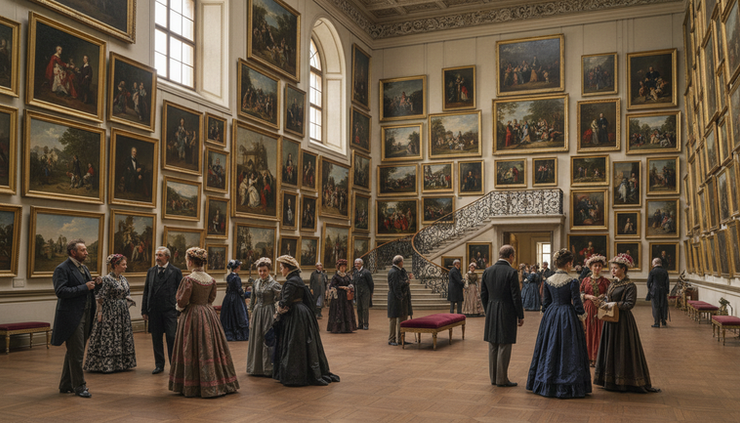
The Paris Salon became one of the most powerful art institutions in Europe. Organized under the authority of the French Academy, it offered public exhibitions where painters and sculptors could gain recognition from critics, patrons, and the public. For generations, success at the Salon could define a career.
The Salon rewarded history painting, religious subjects, mythological scenes, polished technique, and academic finish. Works were hung close together, often from floor to ceiling. Placement mattered. A painting hung “on the line,” near eye level, had a better chance of being seen. A work placed too high could disappear into the crowd.
Artists such as Jacques-Louis David, Jean-Auguste-Dominique Ingres, Eugène Delacroix, and Jean-Léon Gérôme built or strengthened their reputations through Salon culture. Their works entered public debate. Critics reviewed them. Students copied them. Patrons followed them.
The Royal Academy exhibitions in London played a similar role. J.M.W. Turner showed works there and developed a public identity through repeated exhibition. John Constable also gained attention in academy settings, though his reception varied across Britain and France. These events turned art into a social subject. People discussed style, politics, taste, morality, and national identity through paintings on public walls.
The Salon also produced rebellion. Its judges rejected many works that later became central to modern art. The Salon des Refusés of 1863, created after a wave of rejected submissions, famously displayed Édouard Manet’s Le Déjeuner sur l’herbe. The work shocked viewers and helped make Manet a central figure in the move away from academic standards.
Gustave Courbet also understood the power of exhibition. When official systems did not serve him, he created his own display during the 1855 Exposition Universelle in Paris, calling it the Pavilion of Realism. That act pointed toward a future where artists and dealers would seek alternate routes around institutions.
What historical exhibitions showed and what they left out
The art shown at early public exhibitions reflected the values of the institutions that controlled them. Large history paintings, biblical scenes, portraits of the powerful, landscapes, classical nudes, battle scenes, and grand allegories often received prime attention.
Over time, other forms gained ground:
Genre scenes of everyday life
Landscapes and seascapes
Still lifes
Portrait miniatures
Prints and drawings
Decorative arts
Sculpture in marble, bronze, and plaster
Later, photography and design objects
The Impressionists offer one of the clearest examples of artists working around the official system. Claude Monet, Pierre-Auguste Renoir, Camille Pissarro, Berthe Morisot, Edgar Degas, and others organized independent exhibitions beginning in 1874. These were not fairs in the current booth-based sense, but they changed the relationship between artists, dealers, critics, and buyers.
Their exhibitions showed looser brushwork, modern leisure, changing light, railway stations, dancers, cafés, gardens, and ordinary urban life. Many viewers mocked the style at first. Dealers such as Paul Durand-Ruel later played a major role in building a market for Impressionism, especially through private galleries and international sales.
This shift matters because it moved power away from a single official jury. The dealer, critic, collector, and independent exhibition became increasingly important. That structure prepared the ground for the modern fair, where galleries bring selected work directly to concentrated groups of buyers.

Sales changed when art became a public market
Historical exhibitions did not always function as direct sales floors. In many cases, they created demand rather than closing sales on the spot. A strong showing could bring portrait commissions, state purchases, church work, private patrons, teaching posts, or dealer interest.
The sales impact came through several channels.
Historical advantage | Historical drawback |
Public visibility could make a career quickly. | Selection committees could block new ideas. |
Critics helped works reach a wider audience. | Bad reviews could damage reputations. |
Patrons could compare many artists in one place. | Crowded hanging made many works hard to see. |
State and royal buyers gave status and income. | Taste often favored academic styles. |
Exhibitions built art history through public memory. | Women, outsiders, and nonacademic makers faced barriers. |
World’s fairs and international expositions added another layer. Events such as the Great Exhibition in London in 1851 and later Paris expositions mixed fine art, design, industry, technology, empire, and national display. They drew large crowds and linked art to international prestige.
For artists, this could be powerful. Awards, medals, and state recognition increased market value. A prize could help a painter sell work, attract pupils, or secure commissions. Yet these events also reflected the politics and prejudices of their time. Colonial displays often presented cultures through unequal and distorted lenses. National pavilions could turn art into propaganda.
Still, the basic market lesson endured: when art gathers in public, value becomes social. People do not only ask, “Do I like this?” They ask, “Who else likes it? Who selected it? Who is buying it? What does it mean to own it?”
The twentieth century turned exhibitions into market engines
The modern fair format began to take shape in the twentieth century, especially as galleries became the main bridge between creators and collectors.
The 1913 Armory Show in New York was not a commercial fair in the present sense, but it had the shock effect of a major market event. It introduced many American viewers to European modernism, including works by Marcel Duchamp, Henri Matisse, Pablo Picasso, and other avant-garde figures. Duchamp’s Nude Descending a Staircase, No. 2 became famous partly because it confused and provoked the public.
The Armory Show showed how a temporary exhibition could change taste. It also proved that controversy could create long-term value.
After World War II, the art market expanded through commercial galleries, biennials, museums, and collectors with international reach. In 1967, Art Cologne helped establish the contemporary gallery fair model. Art Basel followed in 1970 and became one of the most influential events in the global market. Other major events later developed in cities including Chicago, New York, Miami Beach, London, Paris, Hong Kong, and Los Angeles.
The fair booth became a new kind of stage. Instead of one academy judging hundreds of submissions, galleries selected the artists they represented and presented them to collectors, curators, advisers, critics, and other dealers. Taste no longer flowed from one institution. It moved through networks.
For galleries, fairs offered access to buyers beyond their home cities. For collectors, they offered comparison at speed. For artists, they created both opportunity and pressure. A booth could introduce work to serious buyers, but it could also compress slow studio practice into a fast sales environment.
Contemporary artists find fairs through galleries, applications, and networks
Most contemporary creators do not simply rent a booth at the largest events. Participation usually happens through one of several paths.
The most common path is gallery representation. A gallery applies to a fair, gets accepted, and decides which works to bring. The artist may attend the opening, meet collectors, speak with curators, or leave sales conversations to the dealer.
Some fairs include solo sections, emerging gallery areas, or curated platforms. These can bring attention to newer names. Smaller fairs and artist-run events may allow direct applications from independent makers. Local and regional fairs often serve as entry points for people without gallery representation.
Discovery also happens through open calls, residencies, graduate exhibitions, nonprofit spaces, online portfolios, studio visits, and word of mouth. A curator sees work in a small show. A dealer visits a studio. A collector buys a piece at an artist-run fair. Later, that work appears in a larger booth.
The phrase “discovered at a fair” can be misleading. Careers rarely begin in one dramatic moment. Still, fairs have helped accelerate visibility for many contemporary figures. Artists such as Amoako Boafo, Loie Hollowell, Tschabalala Self, Njideka Akunyili Crosby, and Lynette Yiadom-Boakye gained wider market attention as their works circulated through high-profile gallery presentations, fair booths, and collector networks. Their careers also depended on studio practice, gallery support, museum interest, and critical writing.
A fair can amplify momentum. It rarely creates it from nothing.

The benefits for artists today are real but uneven
A successful fair can place work in front of people who would never visit a studio. It can create sales, press, museum interest, and long-term relationships. It can also help an artist see how viewers respond in person.
The best benefits include:
Concentrated exposure
A fair brings collectors, curators, dealers, critics, designers, and art lovers into one place over a short period.
Immediate feedback
Viewers reveal what holds attention, what needs more context, and what raises questions.
Sales momentum
A strong fair can sell current work and create demand for future pieces.
Professional credibility
Showing with a respected gallery or curated section can signal that the work has support.
Network growth
Conversations may lead to studio visits, commissions, press, or later exhibitions.
The drawbacks can be just as serious. Booth fees, shipping, insurance, framing, travel, lodging, and staffing can be expensive. Even when a gallery pays upfront costs, the pressure to sell can shape what gets shown. Large, difficult, quiet, or experimental works may lose space to pieces that fit a booth and move quickly.
There is also emotional strain. A fair turns deeply personal work into a public, price-tagged object. Some creators enjoy that exchange. Others find it draining. Rejection can be visible. Sales can become a rough measure of worth, even when they reflect taste, timing, and buyer habits more than artistic value.
Well-known names face another issue: repetition. Collectors may expect a recognizable style. Newer creators may face the opposite problem: they need to be understood quickly in a crowded room.
What artists need before participating
A fair rewards preparation. The booth may look effortless, but the work begins weeks or months earlier.
Start with the basics:
A cohesive body of work
Clear titles, dates, materials, dimensions, and prices
High-quality images of each piece
A short artist statement in plain language
A one-page bio or résumé
A current inventory list
Certificates of authenticity when appropriate
Hanging hardware or display supports
Packing materials suited to each piece
Insurance for transport and display
A plan for payment, receipts, and sales tax where required
Transportation deserves special care. Paintings need corner protection, glassine, cardboard, foam, and sturdy crates or travel frames when needed. Works on paper should travel flat or in proper portfolios unless framed. Sculpture may need custom padding, crates, dollies, and clear handling instructions. Ceramics and glass require serious shock protection and labeling.
For long-distance travel, many artists and galleries use professional art shippers. For local fairs, a personal vehicle may work if the art is packed well, secured upright, protected from heat and moisture, and never left unattended for long.
Setup also needs planning. Bring more than art. Useful supplies often include:
Tape measure and level
Pencil and painter’s tape
Hanging wire, D-rings, screws, hooks, and wall labels
Gloves and cleaning cloths
Touch-up paint if booth walls allow it
Small tool kit
Portable lighting if permitted
Business cards or simple printed takeaway sheets
Phone charger and payment device
Packaging for sold works
The goal is not to bring a whole studio. It is to prevent small problems from becoming expensive distractions.
Display choices can shape sales
A strong booth gives viewers room to think. Too much work can make even good pieces feel weaker. Too little can make the space feel unfinished. The right balance depends on scale, style, and the fair’s audience.
A few display principles help across most settings.
Give the strongest work breathing room. A standout piece near the front can stop passersby, but it should not feel like bait. It should represent the booth honestly.
Hang at a comfortable eye level. Museum height is often around the center of the work at average eye level, but booth conditions vary. Keep sightlines clean and avoid placing important works too low or too high unless the installation calls for it.
Group related works with intention. A set of small works can become powerful when hung as a series. Mixed media, sculpture, and works on paper can add range, but they should still feel connected.
Use labels sparingly but clearly. Viewers need enough information to ask intelligent questions. Title, medium, size, and sometimes price can help. Some fairs prefer price lists rather than wall prices. Follow the rules of the event.
Lighting matters. Uneven light can flatten a painting, create glare on framed works, or make texture hard to read. Test the booth from the aisle as well as up close.
Do not block entry with chairs, bags, or storage boxes. A booth should feel open, not guarded. If the artist is present, standing near the side often feels more welcoming than sitting behind a table.
The best displays support the work without shouting over it.
Pricing should be clear, consistent, and defensible
Pricing art is part math, part market knowledge, and part career strategy. A fair is not the place to invent numbers on the fly.
A simple pricing plan should account for:
Size and materials
Time and complexity
Edition size, for prints or photographs
Framing and production costs
Gallery commission
Past sales history
Career stage
Comparable work in the same market
Consistency matters. If a painting is $3,000 in the booth, it should not be $1,500 on the artist’s website the next week unless there is a clear reason. Price confusion weakens trust.
For emerging sellers, a tiered range can work well. Small works, studies, prints, or drawings may give new collectors an accessible entry point. Larger or more complex works can sit at higher price points. That range lets different buyers participate without forcing discounts.
Discounts require care. Galleries often manage this conversation. Independent sellers should decide ahead of time whether discounts are allowed, for whom, and how much. A modest courtesy discount for a serious collector may make sense. A large discount offered too quickly can make the original price seem inflated.
Payment terms should also be clear. If deposits, installment payments, shipping charges, or framing changes are possible, put the terms in writing. A friendly conversation is not a sales record.
Customer conversations work best when they stay human
People rarely like being pounced on in a booth. They also do not want to be ignored. The best approach is warm, calm, and observant.
A simple greeting works:
“Hi, let me know if you have any questions.”
Then give the viewer space. If they linger, ask something open:
“What caught your eye?”
That question is better than launching into a speech. It lets the visitor reveal whether they care about process, subject, color, story, scale, or price.
When discussing the work, avoid rehearsed art-speak. Speak clearly about materials, ideas, and process. If a piece connects to a place, memory, research interest, or technique, say so in concrete terms. Let the viewer build a relationship with the object.
For serious buyers, be ready with details:
Exact dimensions
Medium and surface
Framing status
Installation needs
Shipping options
Payment methods
Availability of related works
Return or exchange policy, if any
Do not pressure people into buying. Pressure may close a small sale, but it can damage long-term trust. Many fair sales happen after a pause, a second visit, or a follow-up email.
Good customer interaction is not a performance. It is a clear conversation around a meaningful object.

Well-known and emerging creators see fairs differently
Established artists often view fairs through the lens of market management. A fair can support museum relationships, reach international collectors, and maintain visibility between major exhibitions. Yet it can also feel narrow. A booth may not offer the depth of a solo museum show or a carefully paced gallery exhibition.
For emerging artists, fairs can feel more urgent. A single sale may cover materials, rent, or the next body of work. A curator’s visit may lead to a group show. A collector’s early support may matter for years. At the same time, the costs and comparisons can be harsh. A young creator may stand a few aisles away from blue-chip names with decades of market support.
Both groups understand the same truth: fairs are not neutral spaces. They reward clarity, confidence, portability, networks, and timing. They can also reward fashion and speculation. Some works thrive in that setting. Others need more time than a fair allows.
Still, the fair remains one of the few places where so many parts of the art world meet at once. Dealers watch collectors. Collectors watch each other. Curators scan for patterns. Critics read the room. Artists see how their work lives outside the studio.
Why the fair still matters
From medieval trade routes to academy salons, from rejected exhibitions to international booths, the fair has always been more than a marketplace. It is a stage where taste becomes public and value becomes visible.
Its history includes exclusion, gatekeeping, and commercial pressure. It also includes discovery, rebellion, independence, and genuine connection. Manet’s scandal, Courbet’s self-made pavilion, the Impressionists’ independent shows, the Armory Show’s shock, and the rise of modern gallery fairs all point to the same pattern. When artists find new ways to be seen, art history shifts.
For anyone preparing to participate today, the lesson is practical as well as historical. Bring strong work. Pack it well. Price it clearly. Display it with care. Speak about it honestly. Follow up with respect.
A fair cannot define the full worth of an artwork or a career. But it can create the moment when private labor becomes public possibility. That is why, centuries after the first crowded exhibitions, artists still show up, collectors still wander the aisles, and a single work on a temporary wall can still change what happens next.


Comments